
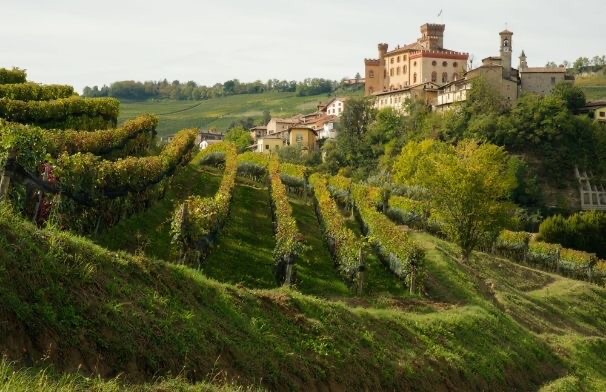
The name ‘Nebbiolo’ derives its name from the Italian word for ‘fog’. This could be due to the grape’s foggy, bloom-covered appearance or, more evocatively, its late harvest in fog-wrapped vineyards – a theory I find particularly captivating.


Originating in pre-Roman times, Nebbiolo’s history is rooted in the Ligurian-Piedmontese area. The ancient writer Columella mentioned Nebbiolo in his first-century treatise ‘De de rustica’, highlighting its longstanding importance. In the Late Middle Ages, documents already praised Nebbiolo (referred to as nebiolius or nibiol) for its noble and long-lasting qualities.
Ampelographers suggest that Nebbiolo is indigenous to Piedmont, though DNA evidence hints at a possible origin in northern Lombardy’s Valtellina area. Its first official record dates back to the 13th century, tracing its lineage to ancient varieties like Vaccarino Nero and Lampia di San Costanzo.
The international spotlight turned to Nebbiolo and the Langhe region around 1844 when French oenologist Louis Oudart, at the behest of Count of Cavour and Juliette Colbert (Giulia di Barolo), transformed Nebbiolo grapes into the esteemed Barolo wine.


Marchesa Giulia di Barolo’s vision and innovation were pivotal in Nebbiolo’s development. Initially, Nebbiolo grapes were made into a partially fermented, sweet, sparkling wine. Giulia’s decision to build new cellars for large cask wine production transformed this sweet beverage into the full-bodied, noble Barolo we know today.
You can read more about this remarkable Queen of Barolo Guila di Barolo, Queen & mother of Barolo
The King of Wines, the Wine of Kings
In the 1800s, King Carlo Alberto and Italy’s first Prime Minister, Camillo Benso, Count of Cavour, favored Barolo at diplomatic events.
Legend has it, the Marchesa was at court and King Carlo Alberto asked her jokingly: “Marchesa, people always speak highly of the wine from your holdings. When will you let us taste it?”
“Your Majesty, your wish will be granted soon” answered the Marchesa.


True to her word after many months finally stable and perfect to be transported for long distances without being altered, she did send 325 caskets of Barolo wine (shown above) that is one for each day of the year minute the quaratine period.
Barolo quickly became the wine of the Savoy court, of ambassadors and high-ranking officers of the army. After a short time, it also reached royal and noble banquets all over Europe.
For this reason it famously earned its epitaph “The King of Wines, the Wine of Kings”.
Meanwhile, other Nebbiolo regions like Monferrato and Roero, traditionally farmed by families, remained less renowned slipping into the shadows, becoming a wine made by simple farming families, no more prized than their peaches or grain.
Where can I find Nebbiolo?
Nebbiolo is synonymous with Piedmont. In the Langhe, especially around Barolo and Barbaresco, it’s used to craft iconic wines like Barolo DOCG and Barbaresco DOCG. In the Roero area, along the Tanaro river, you’ll find Roero DOCG with at least 95% Nebbiolo grapes. Further north, in Novara and Vercelli, Nebbiolo is blended with Vespolina grapes for Gattinara and Ghemme wines.
While top-tier Barolo and Barbaresco can be pricey (aging enhances their drinkability), more accessible blends with Barbera are available. Nebbiolo wines are renowned for their complex flavors – think violets, wild herbs, cherries, raspberries, and truffles.
Moving north, Nebbiolo is grown with excellent results even between Novara and Vercelli: here the DOCG Gattinara and Ghemme wines are born, where Nebbiolo is usually used for niche productions blended with Vespolina grapes.
Nebbiolo wines are known for their complex flavors and aromas. They have a brick-orange hue at the rim of the glass and mature to reveal other aromas and flavors such as violets, wild herbs, cherries, raspberries, truffles, tobacco, and prunes 21.
For those interested in exploring Nebbiolo wines, Piedmont is the place to be. Here, the wines are vibrant, with tart blackberry notes and bright acidity. We recommend visiting Barolo and exploring its historic cellars. You can book a visit or a tasting, starting at €35 per person, at the Marchesi Di Barolo estate.”
Leave a Reply